You step on a scale and see a number. Maybe it’s gone up, maybe it’s gone down. But what does that number actually tell you about your health? Almost nothing.
That number doesn’t tell you if you’ve gained muscle or fat. It doesn’t tell you if you’re losing bone density. It doesn’t tell you if you’re carrying dangerous visceral fat around your organs or if your weight is distributed in healthier patterns. And it certainly doesn’t tell you if your diet and exercise program is actually working the way you think it is.
This is where DEXA scans come in. A DEXA scan (Dual-Energy X-ray Absorptiometry) is the gold standard for measuring body composition and bone density. It’s the same technology used in research studies, by professional athletes tracking performance, and by physicians assessing metabolic health and fracture risk.
A DEXA scan tells you exactly how much muscle you have, where you’re storing fat, how your bone density compares to healthy standards, and whether your body composition is putting you at risk for metabolic disease. It’s the difference between guessing and knowing.
This guide will walk you through everything you need to know about DEXA scans: what they measure, how they work, who should get them, how to interpret your results, and how to use that information to actually improve your health.
What Is a DEXA Scan?
DEXA stands for Dual-Energy X-ray Absorptiometry, which sounds intimidating but is actually pretty straightforward. The technology uses two different low-dose X-ray beams to measure three components of your body: bone mineral content, lean tissue (muscle), and fat tissue.
The scan works because different tissues in your body absorb X-rays differently. Bone absorbs X-rays most strongly, muscle tissue absorbs them moderately, and fat tissue absorbs them least. By using two different X-ray energies, the DEXA machine can distinguish between these three tissue types with remarkable precision.
Originally, DEXA scans were developed specifically to measure bone density and assess osteoporosis risk. Doctors needed a way to identify people at risk for fractures before they actually broke a bone. But researchers quickly realized the technology could do much more. The same scan that measures bone density also provides incredibly accurate body composition data.
Today, DEXA scans are used for both purposes: clinical bone density assessment and body composition analysis. This makes them uniquely valuable because you’re getting comprehensive information about multiple aspects of your health in a single, quick, non-invasive test.
What Does a DEXA Scan Measure?
Let’s break down exactly what information you’re getting from a DEXA scan.
Body Composition: Fat, Muscle, and Bone
A DEXA scan divides your body into three components and tells you exactly how much of each you have, measured in both absolute amounts (pounds or kilograms) and percentages.
Your lean body mass is everything that isn’t fat or bone—primarily your muscle tissue, but also organs, skin, and connective tissue. This number tells you how much functional tissue you have. More lean mass generally means better metabolic health, better physical function, and better longevity outcomes.
Fat mass is exactly what it sounds like—all the adipose tissue in your body. But here’s where DEXA really shines: it doesn’t just give you a total body fat percentage. It shows you where that fat is distributed. You can see how much fat you’re carrying in your arms, legs, trunk, and critically, in your android region (your abdomen).
This regional analysis matters enormously because not all fat is created equal. Subcutaneous fat under your skin is relatively benign. Visceral fat around your organs—what shows up in your android region measurement—is metabolically active tissue that drives inflammation, insulin resistance, and cardiovascular disease. You can be “normal weight” according to BMI but still carry dangerous amounts of visceral fat.
Bone mineral content and density tell you how strong your skeleton is. Low bone density increases fracture risk, which becomes increasingly important as we age. Hip fractures in elderly people are associated with significant mortality and loss of independence. A DEXA scan catches bone density problems early, when intervention can still make a difference.
Regional Analysis: Where Your Body Composition Matters
The DEXA scan doesn’t just give you total body numbers. It breaks down your composition by region: arms, legs, trunk, android (abdomen), and gynoid (hips and thighs).
This regional data reveals patterns you’d never see from a scale or even from looking in the mirror. You might discover you’re losing muscle mass in your legs faster than in your arms, which has implications for mobility and fall risk. You might find that you’re carrying most of your fat in your trunk rather than your hips and thighs, which indicates higher metabolic risk.
For athletes and people focused on performance, this regional data helps optimize training. Are you building muscle evenly on both sides, or do you have imbalances that could lead to injury? Is your training program actually building the muscle you’re targeting?
Bone Density Scores: T-Score and Z-Score
Your DEXA scan provides specific scores that indicate your bone health. The T-score compares your bone density to that of a healthy 30-year-old of the same sex. This is the standard used to diagnose osteopenia (low bone mass) and osteoporosis.
A T-score of -1.0 or above is considered normal. Between -1.0 and -2.5 indicates osteopenia. Below -2.5 indicates osteoporosis, which significantly increases fracture risk.
The Z-score compares your bone density to the average for someone of your same age, sex, and body size. This helps identify if your bone density is lower than expected for your age, which might indicate an underlying health issue affecting bone health.
These scores give you and your doctor concrete numbers to work with rather than vague assessments. You know exactly where you stand and whether intervention is needed.
Visceral Adipose Tissue (VAT)
This is one of the most valuable measurements a DEXA scan provides, and it’s something you can’t get from a scale, BMI calculation, or even from looking at yourself.
Visceral adipose tissue is the fat stored around your internal organs in your abdominal cavity. It’s different from subcutaneous fat, which sits under your skin. Visceral fat is metabolically active—it releases inflammatory compounds and hormones that drive insulin resistance, cardiovascular disease, and metabolic dysfunction.
Research consistently shows that visceral fat is a stronger predictor of metabolic disease than total body weight or even total body fat percentage. You can have a “normal” BMI but dangerous levels of visceral fat. This is sometimes called “skinny fat” or metabolically obese normal weight.
A DEXA scan quantifies your visceral fat, typically giving you a volume measurement in cubic centimeters or a VAT mass. This number gives you a clear target: reduce visceral fat to improve metabolic health, regardless of what’s happening with your total body weight.
Why DEXA Scans Are More Accurate Than Other Methods
You have lots of options for assessing body composition: bathroom scales, body fat scales that use bioelectrical impedance, skinfold calipers, underwater weighing, and various other methods. So why is DEXA considered the gold standard?
The Problem with BMI
BMI (Body Mass Index) only considers your height and weight. It tells you nothing about body composition. A muscular athlete and an obese person can have identical BMIs. BMI can’t distinguish between fat and muscle, can’t tell you about fat distribution, and provides zero information about bone health.
According to BMI, many professional athletes are “overweight” or even “obese.” Meanwhile, plenty of people with “normal” BMIs have high body fat percentages and low muscle mass—a condition associated with poor health outcomes. BMI is a population-level screening tool, not an individual health assessment.
The Problem with Bioelectrical Impedance (Home Scales)
Those scales and handheld devices that claim to measure body fat work by sending a small electrical current through your body. The principle is that muscle conducts electricity better than fat, so the device can estimate body composition based on impedance.
The problem is these measurements are extremely variable. Your hydration status, when you last ate, skin temperature, and even where you place your feet on the scale can dramatically affect the reading. Studies show bioelectrical impedance can be off by 5-8% or more in body fat percentage. That’s the difference between lean and overweight.
These devices also can’t measure regional composition or bone density. They’re giving you a rough estimate at best, and that estimate might be significantly wrong.
The Problem with Skinfold Calipers
Skinfold measurements can be reasonably accurate when performed by experienced technicians, but they’re highly dependent on operator skill. Different people measuring you will get different results. Even the same person measuring you on different days might get inconsistent readings.
Calipers only measure subcutaneous fat in specific locations. They can’t assess visceral fat, can’t measure muscle mass accurately, and tell you nothing about bone density.
Why DEXA Is Different
DEXA scans are direct measurements, not estimates. The machine is literally measuring how much X-ray energy is absorbed by different tissues in your body. The technology is precise, reproducible, and not affected by hydration status, recent meals, or operator skill.
Studies show DEXA scans have a margin of error of less than 1-2% for body fat percentage. That’s dramatically better than any other widely available method. When you get a DEXA scan, you’re getting research-grade data about your body composition.
The regional analysis and visceral fat quantification provide information you simply cannot get from other methods. And you’re getting a bone density assessment at the same time, which is crucial for long-term health but completely ignored by other body composition tools.
Who Should Get a DEXA Scan?
DEXA scans are valuable for a wide range of people, but they’re particularly useful in specific situations.
Anyone Tracking Body Composition Changes
If you’re trying to lose fat and build muscle, a DEXA scan is the only way to know if your program is actually working. The scale might go down, but are you losing fat or muscle? It might stay the same—are you successfully recomping (losing fat while gaining muscle), or are you spinning your wheels?
Without accurate data, you’re guessing. With a DEXA scan, you know. This allows you to adjust your diet and training based on what’s actually happening in your body, not what you hope is happening.
People Taking GLP-1 Medications
If you’re taking semaglutide (Ozempic, Wegovy), tirzepatide (Mounjaro, Zepbound), or other GLP-1 receptor agonists for weight loss, a DEXA scan is essential before starting treatment and during your weight loss journey.
GLP-1 medications are incredibly effective for weight loss—that’s not in question. But here’s what most people don’t realize: studies show that approximately 25-40% of weight lost on these medications can be lean tissue rather than fat. For someone losing 50 pounds, that could mean losing 12-20 pounds of muscle along with the fat.
This matters enormously. Losing significant muscle mass while losing weight:
- Slows your metabolism, making it harder to maintain weight loss after stopping the medication
- Reduces physical function and increases fall risk, especially as you age
- Can leave you looking and feeling weaker despite weighing less
- Makes it much more difficult to keep the weight off long-term
A DEXA scan before starting GLP-1 treatment establishes your baseline body composition. Then, scanning every 3-4 months while on medication allows you to see exactly what you’re losing. If you’re losing too much muscle relative to fat, you can adjust your approach—increasing protein intake, starting or intensifying resistance training, or working with your doctor on dosing strategies.
The goal isn’t just to lose weight. It’s to lose the right kind of weight while preserving the muscle and bone density that keep you healthy and functional. A DEXA scan makes that possible.
Women Over 40 and Men Over 50
Bone density starts declining with age, and the decline accelerates during and after menopause for women. Getting a baseline DEXA scan in your 40s or 50s establishes where you stand and whether you need to take action to protect bone health.
Osteoporosis is often called a “silent disease” because you don’t know you have it until you fracture a bone. A DEXA scan catches bone density loss early, when dietary changes, exercise (especially resistance training), and if needed, medication can still make a meaningful difference.
Muscle loss also accelerates with age, a condition called sarcopenia. After 30, most people lose 3-5% of their muscle mass per decade if they’re not actively working to maintain it. This muscle loss drives metabolic decline, increases fall risk, and reduces quality of life. A DEXA scan quantifies your muscle mass so you can work to maintain or build it.
People with Metabolic Concerns
If you have insulin resistance, prediabetes, type 2 diabetes, or metabolic syndrome, your visceral fat level is crucial information. Reducing visceral fat is one of the most effective ways to improve insulin sensitivity and metabolic health.
A DEXA scan gives you a baseline measurement and allows you to track changes. You can watch your visceral fat decrease as your metabolic health improves, which provides powerful motivation to stick with dietary and lifestyle changes.
Athletes and Performance-Focused Individuals
Athletes use DEXA scans to optimize body composition for performance. A runner might want to reduce body fat while maintaining muscle mass. A strength athlete wants to build muscle while controlling fat gain. A fighter needs to hit a weight class while preserving strength and power.
DEXA scans provide objective feedback on whether training and nutrition protocols are working. They can also reveal imbalances—if you’re building muscle on one side but not the other, for example—that could lead to injury.
Anyone with Family History of Osteoporosis
If your mother, grandmother, or other family members have experienced fractures or been diagnosed with osteoporosis, you’re at elevated risk. A DEXA scan helps you understand your current bone density and whether you need to take preventative measures.
Bone health is much easier to maintain than to rebuild. If you wait until you’ve already lost significant bone density, intervention becomes more difficult and less effective.
People Who Feel Stuck
You’re eating well and exercising but not seeing results. Or you’ve lost weight but don’t look or feel the way you expected. A DEXA scan can explain why. Maybe you’ve lost muscle along with fat, which is why your metabolism has slowed. Maybe you still have high visceral fat despite losing weight, which is why you’re still dealing with metabolic issues.
Understanding what’s actually happening in your body allows you to adjust your approach strategically rather than just trying different things and hoping something works.

What to Expect During a DEXA Scan
If you’ve never had a DEXA scan, you might be wondering what the experience is like. The good news is it’s quick, non-invasive, and requires no preparation beyond a few simple guidelines.
Before Your Scan
There’s minimal preparation needed. You don’t need to fast, though some providers recommend avoiding calcium supplements for 24 hours before your scan since they can occasionally show up in the imaging.
Wear comfortable clothing without metal. Zippers, buttons, underwire bras, or metal embellishments can interfere with the scan.
Remove jewelry, watches, belts, and anything else metal. If you have metal implants from surgery, that’s fine—the technician just needs to know about them so they can note it in your report.
For women, if there’s any possibility you could be pregnant, let the technician know. While DEXA scans use very low radiation doses, it’s standard practice to avoid unnecessary radiation during pregnancy.
During the Scan
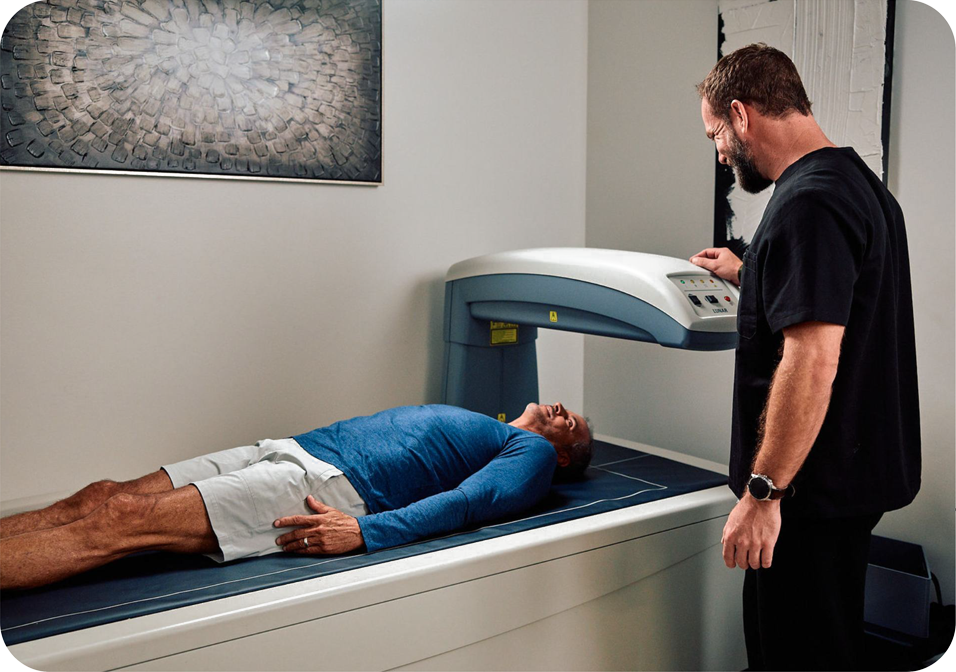
You’ll lie flat on your back on the scanning table. The table is open—there’s no enclosed tube like with an MRI, so if you’re claustrophobic, a DEXA scan won’t be a problem. The scanner arm passes over your body from head to toe, but you have plenty of space and can see around the room the entire time.
The technician will position your legs and arms in specific ways to ensure accurate regional measurements. Your arms will be placed at your sides or slightly away from your body.
Then you just lie still. That’s it. You don’t need to hold your breath or do anything special. The scan takes about 10-30 minutes for a whole-body composition scan. Bone density-only scans of the hip and spine take even less time.
The scanner makes a quiet humming sound as the arm passes over you. Some people find it relaxing and almost fall asleep. There’s no discomfort, no pain, no injections or needles. It’s honestly one of the easiest medical tests you can have.
After the Scan
Once the scan is complete, you’re done. There’s no recovery period, no side effects, no restrictions on your activities. You can get up and go about your day immediately.
Your results are typically available within a few days to a week, depending on the facility. Some providers offer same-day preliminary results. You’ll receive a detailed report showing your body composition measurements, bone density scores, and often visual representations of your fat and muscle distribution.
Many facilities schedule a follow-up consultation to review your results and discuss what they mean for your health and goals. This is valuable because the numbers by themselves don’t tell you what to do next—you need interpretation and guidance.
Understanding Your DEXA Scan Results
Getting your DEXA scan report is one thing. Understanding what those numbers mean and what to do with them is another. Let’s break down how to interpret your results.
Body Fat Percentage: What’s Healthy?
Your body fat percentage is probably the number most people focus on first. But “healthy” body fat percentage varies by age, sex, and individual goals.
For men, essential fat is around 2-5%. Athletic range is 6-13%, fitness range is 14-17%, average is 18-24%, and above 25% is considered obese. For women, essential fat is 10-13%, athletic is 14-20%, fitness is 21-24%, average is 25-31%, and above 32% is considered obese.
These are general guidelines, and where you want to be depends on your goals. An athlete might target the lower ranges for performance. Someone focused on health and longevity might be perfectly healthy in the average range, especially as they age.
What matters more than hitting a specific number is your trend over time. Are you moving in the right direction? If you’re trying to reduce body fat, is it actually decreasing? If you’re trying to maintain, is it stable?
Lean Body Mass: Are You Losing Muscle?
Your total lean mass includes muscle, organs, skin, and connective tissue. For most people, changes in lean mass primarily reflect changes in muscle mass.
There aren’t universal standards for lean mass like there are for body fat percentage because it varies so much by height, frame size, and genetics. What matters is tracking your lean mass over time.
If you’re trying to build muscle, is your lean mass increasing? If you’re dieting, are you preserving lean mass while losing fat? If you’re aging, are you maintaining muscle or experiencing accelerated loss?
Age-related muscle loss is a serious concern. After 30, most people lose 3-5% of muscle mass per decade without intervention. This drives metabolic decline, increases fall risk, and reduces quality of life. Your DEXA scan can catch this early so you can take action.
Visceral Fat: The Number That Matters Most
Your visceral adipose tissue (VAT) measurement might be the most important number on your entire report from a metabolic health perspective.
Research shows that visceral fat area above 100 square centimeters or VAT mass above approximately 1-1.5 kg is associated with increased risk of metabolic syndrome, type 2 diabetes, and cardiovascular disease. The higher your visceral fat, the higher your risk.
Some reports express this as an android/gynoid ratio—the ratio of fat in your abdomen to fat in your hips and thighs. Higher ratios (more fat in your abdomen relative to your hips) indicate higher metabolic risk. For men, a ratio above 1.0 is concerning. For women, above 0.8.
If your visceral fat is elevated, this should be your primary target. Reducing visceral fat through diet, exercise, and lifestyle changes improves insulin sensitivity, reduces inflammation, and lowers disease risk more effectively than almost any other intervention.
Bone Density: Understanding T-Scores
Your bone density report focuses on your hip and spine, the two most critical sites for fracture risk. The T-score is the number that determines diagnosis.
A T-score of -1.0 or above means your bone density is normal. Between -1.0 and -2.5 indicates osteopenia, which means low bone mass but not yet osteoporosis. Below -2.5 indicates osteoporosis, which significantly increases your risk of fracture.
If you’re diagnosed with osteopenia or osteoporosis, don’t panic. This is information you can act on. Weight-bearing exercise, especially resistance training, helps maintain and build bone density. Adequate calcium and vitamin D are essential. In some cases, medication can significantly improve bone density and reduce fracture risk.
The key is catching bone density loss early. Once you’ve lost significant bone density, it’s much harder to rebuild. But if you catch osteopenia early, you have a good chance of preventing progression to osteoporosis.

How Often Should You Get a DEXA Scan?
The frequency of DEXA scans depends on your goals and situation.
For Body Composition Tracking
If you’re actively working on changing your body composition—losing fat, building muscle, or recomping—scanning every 3-6 months makes sense. This gives you enough time to see meaningful changes while providing regular feedback to adjust your approach.
Scanning more frequently than every 3 months usually isn’t worthwhile. Body composition changes happen relatively slowly, especially if you’re doing it right (losing fat while preserving muscle takes time). Monthly scans would mostly show normal fluctuations rather than true changes.
Once you’ve reached your body composition goals and are in maintenance mode, annual scans are usually sufficient to ensure you’re staying on track.
For Bone Density Monitoring
Bone density changes even more slowly than body composition. For bone density monitoring, the standard recommendation is every 2 years for most people.
If you’ve been diagnosed with osteopenia or osteoporosis and are undergoing treatment, more frequent scanning (every 1-2 years) helps assess whether treatment is working. Your doctor will guide you on appropriate timing.
If you have significant risk factors for bone loss—early menopause, long-term steroid use, hyperparathyroidism, or other conditions affecting bone health—more frequent monitoring might be appropriate.
For Metabolic Health
If you’re working to improve metabolic health and reduce visceral fat, scanning every 3-6 months during active intervention makes sense. Once your visceral fat is in a healthy range, annual scans help ensure you’re maintaining your improvements.
The cost and radiation exposure (which is very low but not zero) don’t justify scanning more frequently than necessary. Find a rhythm that provides useful feedback without becoming excessive.
What to Do With Your DEXA Scan Results
Getting your scan results is just the beginning. The real value comes from using that information to improve your health.
If Your Body Fat Is Higher Than You Want
Focus on creating a moderate calorie deficit through a combination of dietary changes and increased activity. But here’s the key: you want to lose fat while preserving muscle. This requires adequate protein intake (typically 0.7-1.0 grams per pound of body weight) and resistance training to signal your body to maintain muscle mass.
Crash diets and excessive calorie restriction often result in losing muscle along with fat, which slows your metabolism and leaves you worse off long-term. Use your DEXA scan to monitor progress and ensure you’re losing primarily fat.
If Your Muscle Mass Is Low
Prioritize resistance training at least 2-3 times per week. Progressive overload—gradually increasing the weight, reps, or difficulty of your exercises—is essential for building muscle. You can’t build muscle without providing a stimulus that requires adaptation.
Ensure adequate protein intake. Building muscle requires the raw materials, and protein is the primary building block. Most people trying to build muscle benefit from around 0.8-1.0 grams of protein per pound of target body weight.
Be patient. Muscle building is slow, especially if you’re not a beginner. Gaining 5-10 pounds of muscle in a year is realistic and impressive. Use your DEXA scans every 3-6 months to confirm you’re moving in the right direction.
If Your Visceral Fat Is Elevated
Reducing visceral fat requires addressing both exercise and nutrition, but diet is particularly important. Visceral fat is very responsive to dietary changes, especially reducing refined carbohydrates and sugar.
Focus on whole foods, adequate protein, plenty of vegetables, and minimizing processed foods and added sugars. Regular physical activity, especially a combination of resistance training and cardiovascular exercise, helps reduce visceral fat and improve insulin sensitivity.
The good news is visceral fat typically decreases faster than subcutaneous fat when you lose weight. As you create a calorie deficit and improve insulin sensitivity, you’ll preferentially lose the dangerous belly fat.
If Your Bone Density Is Low
Start weight-bearing exercise immediately. Resistance training is particularly effective for building and maintaining bone density because it creates mechanical stress on your bones, signaling them to become stronger.
Ensure adequate calcium (1000-1200 mg daily for most adults) and vitamin D (have your levels tested—many people need supplementation). These are the raw materials for bone building.
Consider consultation with your doctor about whether medication is appropriate, especially if your T-score indicates osteoporosis. Medications like bisphosphonates can significantly improve bone density and reduce fracture risk.
Avoid smoking and limit alcohol, both of which negatively affect bone health. Make fall prevention a priority as well—reducing your risk of falling is just as important as improving bone density.
DEXA Scans vs Other Body Composition Methods
We touched on this earlier, but let’s dive deeper into how DEXA compares to alternatives.
DEXA vs Hydrostatic (Underwater) Weighing
Hydrostatic weighing used to be considered the gold standard before DEXA became widely available. The principle is that muscle sinks and fat floats, so by weighing you underwater, body composition can be calculated.
The method can be accurate but has significant drawbacks. It’s uncomfortable—you have to sit submerged in water while exhaling all the air from your lungs. It requires special facilities that many people don’t have access to. It doesn’t provide regional analysis or bone density information. And accuracy depends on completely exhaling, which is difficult and inconsistent.
DEXA provides equal or better accuracy without these limitations.
DEXA vs Bod Pod (Air Displacement)
The Bod Pod uses air displacement instead of water displacement to estimate body composition. You sit in an enclosed chamber while it measures how much air your body displaces.
Like hydrostatic weighing, it can be reasonably accurate for total body fat percentage but provides no regional analysis, no bone density information, and no direct measurement of visceral fat. It’s also not widely available and can be uncomfortable for claustrophobic individuals.
DEXA vs 3D Body Scanning
New technologies like 3D body scanners create detailed visual models of your body shape and can estimate body composition based on measurements and algorithms.
These can be useful for tracking changes in body shape and measurements, but they’re still estimates rather than direct measurements. They can’t measure bone density, can’t directly measure visceral fat, and aren’t as accurate as DEXA for body fat percentage.
The Bottom Line
For comprehensive assessment of body composition, regional fat distribution, visceral fat, and bone density, nothing matches DEXA scanning. It’s the only method that gives you all this information simultaneously with research-grade accuracy.

Common Questions About DEXA Scans
Is the radiation exposure dangerous?
DEXA scans use very low radiation doses—about 1-10 microsieverts, depending on the specific scan type. For comparison, you’re exposed to about 10 microsieverts of natural background radiation just from living on Earth for a single day. A cross-country flight exposes you to about 40 microsieverts.
The radiation exposure from a DEXA scan is roughly equivalent to one day of natural background radiation or a few hours on an airplane. This is considered completely safe and is why DEXA scans can be repeated regularly without concern.
Can I eat before a DEXA scan?
Yes, eating before a DEXA scan doesn’t affect the results. Unlike bioelectrical impedance, DEXA measurements aren’t influenced by your hydration status or recent meals. You can eat and drink normally before your scan.
Some providers suggest avoiding calcium supplements for 24 hours before a bone density scan since they can occasionally show up in the imaging, but this is a minor concern.
Will my weight affect the accuracy?
DEXA scanners have weight limits, typically around 300-400 pounds depending on the specific machine. If you’re above the weight limit, you may not be able to get a scan or may need to find a facility with a bariatric scanner.
Within the weight capacity, DEXA scans are accurate across a wide range of body sizes. The machine is designed to work whether you’re lean or carrying more body fat.
Can I get a DEXA scan if I have metal implants?
Yes, metal implants from surgery (plates, screws, joint replacements) don’t prevent you from getting a DEXA scan. The technician just needs to know about them so they can note it in your report. The implants might affect measurements in the immediate area but won’t impact your overall body composition assessment.
How much does a DEXA scan cost?
Pricing varies significantly by location and facility. Body composition DEXA scans typically range from $75 to $150 for a direct-pay scan. Bone density scans ordered by a physician for medical reasons may be covered by insurance, especially for patients with risk factors.
Many facilities offer package deals if you purchase multiple scans upfront, which makes sense if you plan to track changes over time.
Do I need a doctor’s order?
For body composition assessment, most facilities don’t require a doctor’s order—you can simply schedule and pay for the scan directly. For bone density assessment for osteoporosis screening, insurance may require a physician order, but you can still get the scan without one if you’re paying out of pocket.
Putting It All Together: Your DEXA Scan Action Plan
A DEXA scan is an investment in understanding your body. Here’s how to maximize the value.
First, schedule your baseline scan. Pick a facility that provides comprehensive reporting and ideally offers interpretation and consultation. You want more than just numbers—you want to understand what those numbers mean.
When you get your results, schedule time to review them thoroughly. If the facility offers consultation, take advantage of it. If not, consider bringing your results to a knowledgeable healthcare provider, personal trainer, or nutrition coach who can help you interpret them and create an action plan.
Set specific, measurable goals based on your results. Maybe you want to reduce body fat by 5%, or build 10 pounds of muscle, or reduce your visceral fat area below 100 square centimeters. Having concrete targets helps focus your efforts.
Implement your plan. Whether that means adjusting your nutrition, starting a structured exercise program, working with a coach, or consulting with your doctor about bone health, take action based on what your scan revealed.
Schedule your follow-up scan for 3-6 months later if you’re actively working on body composition changes, or 1-2 years later if you’re monitoring bone density. This creates accountability and lets you see objective evidence of your progress.
When you get your follow-up scan, compare the results carefully. Are you moving toward your goals? What’s working? What needs adjustment? Use this information to refine your approach and keep improving.
Remember: the scan itself doesn’t change anything. It’s what you do with the information that matters. A DEXA scan is a tool for making better decisions about your health, but you still have to do the work.
Get Your Baseline DEXA Scan at Preamble Health
At Preamble Health, we use DEXA scanning as a cornerstone of our comprehensive health assessments. Whether you’re an athlete optimizing performance, someone focused on metabolic health, or anyone who wants accurate data about their body composition and bone density, a DEXA scan provides the information you need to make informed decisions.
Our scans include detailed reporting, interpretation, and guidance on how to use your results to improve your health. We don’t just hand you numbers—we help you understand what they mean and what to do about them.
Ready to stop guessing and start knowing?